
IN PARTNERSHIP WITH

Good day, dear reader - The Whale Investor here.
Most investors treat the stock market like a heartbeat monitor, waiting for the chart to tell them when danger is coming. But by the time the market speaks, the truth is already old news. Real warning signs don’t appear at the surface - they move silently underneath.
And right now, those deep indicators are flashing something we have not seen since 2007: a full-spectrum red alert across seven historically reliable early-warning signals.
Let’s examine what the deeper water is telling us today.
Surface Calm vs. Structural Stress
Markets look steady. Economic headlines are optimistic. Volatility appears contained. It’s the kind of environment that lulls most investors into complacency.
But markets don’t break when things look frightening.
They break when things look comfortable.
Underneath that calm, the structural stress has been building: liquidity thinning, credit costs rising, savings eroding, and leverage climbing. These shifts happen slowly, quietly - long before the public notices.
What Bellwethers Really Measure
Bellweather indicators don’t track hype, news, or sentiment.
They track conditions - the underlying health of the system:
liquidity flow
institutional hedging
credit fragility
inflation-adjusted income
bond market stress
Each indicator alone provides a clue.
Together, they provide clarity.
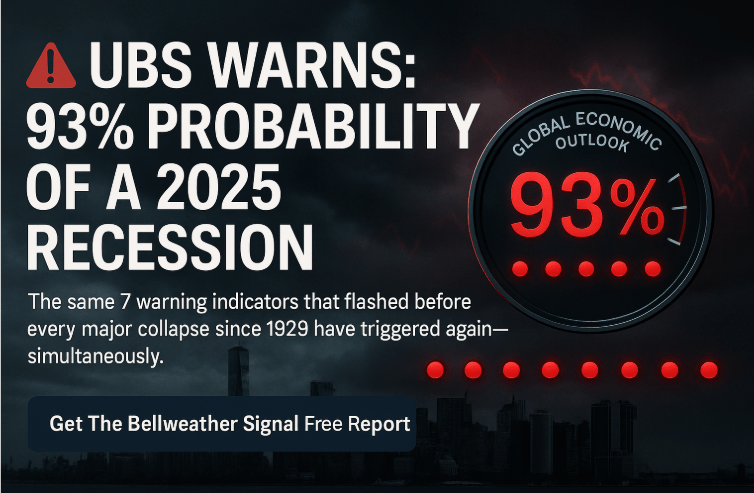
These seven indicators have predicted every major U.S. economic collapse since 1929 - and today, for the first time since the run-up to the 2008 crisis, all seven are signaling danger simultaneously.
Why Crashes Always Start Before Anyone Notices
Market crashes begin long before prices collapse.
Institutions reposition. Hedge funds hedge. Bond markets distort. Central banks send subtle signals.
By the time the average person sees the crash on their screen, the smart money has already moved.
That’s why the convergence of these seven indicators matters - not for fear, but for foresight.
|
The Seven Warnings Beneath the Surface
Each bellwether reflects a different type of stress inside the economy:
Treasury liquidity fractures
When the world’s “safest” asset becomes difficult to trade, systemic risk is quietly rising.
Corporate debt overload
Companies don’t borrow heavily when times are good - they borrow when they’re struggling.
Yield curve inversion
A historically accurate recession signal, now deeply inverted for a prolonged period.
Institutional hedging
Big money protects itself long before regular investors smell danger.
Falling real wages
Consumers lose purchasing power, weakening the backbone of the economy.
Shrinking M2 liquidity
When money supply tightens, markets eventually follow.
Foreign reserve de-dollarization
Central banks shifting out of dollars signal long-term instability.
Individually, any one of these would justify caution.
Together, they form an unmistakable pattern.
Positioning Before the Tide Turns
This isn’t about predicting a crash “tomorrow.”
It’s about understanding when the conditions for a crash are fully present.
During these phases, the most resilient strategies tend to include:
maintaining personal liquidity
reducing exposure to over-leveraged assets
favoring hard assets over paper claims
building cash-flow resilience
avoiding emotional allocation decisions
Markets reward preparation, not reaction.
The Opportunity in Tangible Assets
Gold and silver outperform in crisis cycles not because they are exciting - but because they are solid.
They don’t default.
They don’t rely on corporate earnings.
They don’t lose value because of policy errors.
They aren’t dependent on leverage or liquidity.
When stress rises, markets rediscover the value of what cannot be printed or engineered.
That is why a growing number of macro investors are quietly increasing their exposure to hard assets while the broader public remains complacent.
Why Bellwether Signals Matter Now
Every major downturn in history shares a common trait:
Smart capital moves early.
Before 2008, institutional hedging and liquidity cracks were visible six months before the collapse.
Before 2000, treasury signals and earnings divergences showed up long before the dot-com bubble burst.
Before 2020, bond market stress appeared months ahead of the March liquidity crisis.
The public always finds out at the end.
Whales position at the beginning.
🌊 Whale’s Fact Break
A blue whale’s low-frequency call can travel hundreds of miles underwater - long before any surface disturbance appears.
Markets behave the same way:
The early signals always appear deep in the system - not in prices, not in headlines, and not in sentiment.
Top Picks
Whale’s Final Word
Cycles don’t reverse when people expect.
They reverse when the foundations shift.
Right now, those foundations are sending a clear message:
Don’t wait for the surface to crack.
The deeper currents have already changed direction.
Prepare early.
Move deliberately.
Build protection before the tide turns.
Swim smart,
— The Whale Investor
