

In Partnership With

The "Nvidia Regret" Syndrome: Why Chasing Chips Now is a Sucker's Bet
Let’s be honest: You missed Nvidia.
We all have that friend. The guy who bought NVDA in 2014, forgot about it, and is now shopping for a second home in Aspen. If you put $10,000 into Nvidia a decade ago, you’d be sitting on over $1.25 million today.
That’s a painful math equation to look at. It stings. And that sting drives retail investors to do something incredibly stupid: They chase the past.
Right now, millions of Americans are piling into Nvidia at all-time highs, praying for a repeat performance. They are buying the top. They are providing exit liquidity for the institutional Whales who bought in 2014.
The "Second Wave" Thesis
Here is what the smart money knows that the retail herd misses: The hardware trade is crowded.
The first phase of any tech revolution is infrastructure. In the 1850s, it was railroads. In the 1990s, it was fiber optic cables (Cisco). In the 2020s, it’s GPU chips (Nvidia).
But the second phase - the phase that creates the broadest wealth - is the Application Layer. It’s the companies that build the businesses on top of that infrastructure.
The railroads got built, but the fortunes were made by Standard Oil and Sears utilizing those rails. The internet got built, but Amazon and Google made the real money using it.
We are entering "AI 2.0." The chips exist. The data centers are being built. Now, the question is: Who is going to actually make money using this stuff?
The "Broken" Industry Opportunity
I always look for broken industries that are ripe for an AI fix. And right now, nothing is more broken than Digital Marketing.
For the last decade, marketing was easy. You bought Facebook ads, tracked people with cookies, and printed money. Then Apple killed the cookie. Privacy laws tightened. Suddenly, brands are flying blind. They are spending billions and getting zero measurable ROI.
This is a trillion-dollar problem. And the "Next Nvidia" won't be a chip maker; it will be the AI software company that solves this specific, expensive problem.
The Whales are looking for a company that uses predictive AI - not to write funny limericks, but to tell a Fortune 500 CMO exactly where to spend their budget to get a return.
That is the holy grail of enterprise software right now. And while everyone is looking at hardware stocks, the smart capital - Adobe, Fidelity Ventures, the real insiders - is quietly funding the software solution.
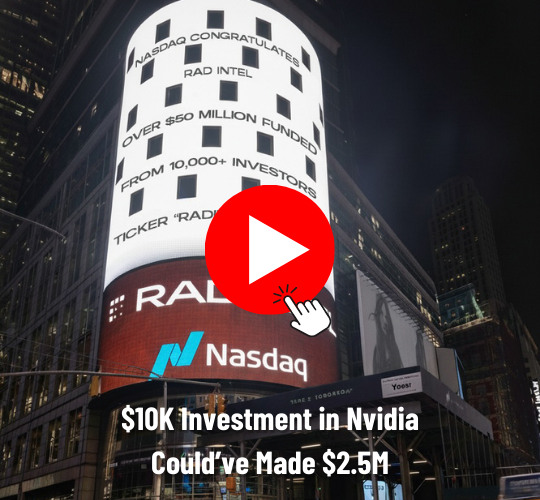
The Pre-IPO Arbitrage: How to Buy the "Next" Before the Bell Rings
We’ve established the macro setup: The easy money in chips has been made. The smart money is rotating into "AI 2.0" - the software that solves massive business problems like marketing ROI.
Now, let’s talk about the specific vehicle to play this.
Usually, when a company like RAD Intel comes along - backed by heavy hitters like Adobe and Fidelity Ventures, growing its valuation by 4,900% in four years - you can’t touch it. It’s locked away in a private equity fund. You have to wait for the IPO, by which point the price has popped 50% on opening day and you’re buying the scraps.
But right now, there is a glitch in the matrix. A window of opportunity where Main Street can sit at the same table as the VCs.
The $0.85 Standoff
RAD Intel is offering shares via a Regulation A+ offering at $0.85.
Let’s look at the signals that matter to a Whale:
The Clients: They aren't testing this in a garage. They have Fortune 1000 clients. Recurring revenue from major corporations is the ultimate validator. It means the tech works.
The Backing: When you see names like Adobe and Fidelity involved, that’s due diligence you can’t buy. These guys don't write checks for vaporware. They know the ad-tech space better than anyone. If they are in, it’s because they see a strategic necessity.
The Ticker: They’ve reserved $RADI on the Nasdaq. That is a clear statement of intent. They aren't planning to stay private forever. They are building a bridge to the public markets.
The Arbitrage Play
The trade here is simple arbitrage. You are buying equity at a fixed, private-market price ($0.85) in a company that is signaling a public listing.
The gap between the "private price" and the potential "public valuation" is where the alpha lives.
When a company like this hits the Nasdaq, the algorithms pick it up. The ETFs buy it. The liquidity premium kicks in. If you own it at $0.85, you are positioned ahead of that entire liquidity event.
Why "AI 2.0" is Sticky
This isn't a fad. Companies using RAD Intel’s software are seeing "intelligent targeting that powers real ROI." In a recessionary environment, companies cut "brand awareness" budgets. They do not cut tools that prove ROI. That makes this revenue sticky. It makes the business model resilient.
The Window is Closing
The promo explicitly states: "Scheduled share price increase soon."
This is the catalyst. In private placements, the price steps up as the company de-risks. Every time they sign a new client or hit a milestone, the cheap shares disappear.
If you are sitting on the sidelines waiting for the perfect moment, you are going to miss the $0.85 entry. You’ll be the guy in 2030 telling your friend, "Yeah, I saw that RAD Intel deal back when it was under a buck, but I hesitated."
Don't be that guy. The Nvidia trade is history. The AI 2.0 trade is happening right now.
Do your homework. Read the offering circular. But recognize that opportunities to buy pre-IPO tech with this kind of backing don't stay open forever.
Whale's Break
The hardware trade (Nvidia) is crowded and overpriced. The smart money is moving to AI Software ("AI 2.0") that solves expensive business problems. RAD Intel offers a rare pre-IPO entry point ($0.85) into a company backed by Adobe and Fidelity.
|
Sponsored Content
Top Picks from Partners We Trust
|
Whale's Final Word
You can keep chasing the stocks that already went up 100x, or you can find the ones that are just getting started. RAD Intel ($RADI) is positioning itself as the leader in AI marketing. The smart money is already there.
- The Whale Investor
If you found $50,000 cash in a bag today, where does it go immediately?
|
Stay ahead of the current - subscribe free
Subscribe to Whales Investing
|
