

I’m staring at a Bloomberg terminal that’s bleeding red across the board, but the whiskey in my glass is smooth, and the data in my private feed is even smoother. The retail crowd is panicking, clutching their index funds like rosary beads, waiting for a Fed pivot that’s always "just around the corner." They don’t see what we see. They don’t understand that the old world - the world of bloated ad agencies and "guesswork" marketing - is being dismantled in the dark.
We don’t look for yield in the headlines. We look for it in the plumbing. Right now, the plumbing of the global marketing machine is being replaced by AI-driven intelligence. While the "herd" is busy debating the ethics of chatbots, the Whales are accumulating positions in the infrastructure that actually dictates where the money flows. We’re talking about Sticky Capital moving into high-performance nodes. We’re talking about a company that has quietly secured its Nasdaq ticker - $RADI - and is currently sitting at a price point that makes the institutional desk salivate.
This isn't about a "stock pick." This is about a Monetary Regime Change in how attention is monetized. If you’re still holding legacy media, you’re the exit liquidity. If you’re watching RAD Intel, you’re the operator.
The Death of the Traditional Ad Treadmill
The old model of marketing was a Treadmill of Despair. Corporations would throw billions at Google and Meta, hoping that some of it would stick. It was inefficient, expensive, and increasingly easy to ignore. But in 2026, the Logic of Desperation has set in. Fortune 1000 brands can no longer afford to waste capital on "vibe-based" advertising. They need precision. They need Sovereign Assets that predict human behavior before the human even knows they’re hungry.
This is where RAD Intel enters the fray. They aren't just another AI company; they are a Liquidity Injection for brands that are starving for ROI. Look at the data: MGM didn’t just "do better" with RAD; they delivered a 3.3X ROI. Skechers didn’t just "get clicks"; they saw an 89% engagement boost. These aren't vanity metrics. In the world of institutional finance, these are Arbitrage opportunities. When you can turn $1 of ad spend into $3.30 of revenue with surgical precision, you aren't just a vendor - you’re the house.
The rebrand from RAD AI to RAD Intel wasn't just a cosmetic change. It was a declaration of war. They are positioning themselves at the center of a $220 billion industry projected to grow at a 26% CAGR. While the retail crowd is chasing the tail end of the semiconductor cycle, the Whales are looking at the software layer that will actually utilize those chips to extract capital from the creator economy. This is the Accumulation Phase that the mainstream media won't tell you about until the ticker is live and the price has tripled.
The AIBO Strategy and the Art of the Hostile Integration

How does a company achieve a 127% CAGR while the rest of the economy is sputtering? You don't do it by waiting for organic growth. You do it through Corporate Warfare. RAD Intel’s AIBO strategy (AI-Enhanced Buyouts) is a masterclass in predatory scaling. They are targeting agencies with $5M to $50M in revenue - companies that have the clients but lack the tech - and they are gutting the inefficiency.
They buy the agency, inject their AI "brain," and suddenly, a sluggish legacy firm becomes a high-output Yield machine. This bypasses the traditional sales cycle. They aren't just winning clients; they are acquiring entire portfolios of Fortune 1000 contracts. This is why their valuation has soared 4900% in just four years. It’s a War Chest strategy. By the time the public realizes what’s happening, RAD Intel will have integrated its "RAD Score" into the very fabric of global advertising.
The RAD Score is the secret sauce. It’s a predictive engine that tells brands exactly what content will move the needle. It’s why Omnicom Group (NYSE: OMC) - a literal titan of the industry - didn’t just try RAD, they renewed their agreement. When the giants of the old world start paying rent to the new world, you know the regime has already shifted. You’re seeing Institutional Accumulation in real-time.
The Deep Dive: Nodes of Power and the Hasbro Connection

In this game, we don't look at companies in isolation. We look at Nodes. A node is a point where multiple streams of capital and influence intersect. When Hasbro (NASDAQ: HAS) partners with RAD Intel to launch their brand portfolio, that’s not a "partnership." It’s a Strategic Alignment. Hasbro owns the IP; RAD Intel owns the intelligence to monetize that IP in the creator-driven economy.
This is particularly vital in the gaming and entertainment sectors, where traditional ads are dead on arrival. You can't force a Gen Z gamer to watch a 30-second spot. You have to use Shadow Liquidity - the influencers and creators who hold the actual trust of the audience. RAD Intel’s recent launch of State-by-State Insights allows for hyper-localized influencer strategies. This is the Granular Arbitrage of attention. They can pinpoint exactly which influencer in Ohio will drive sales for a specific toy, and which one in California will fail.
Even the distribution giants are bending the knee. National CineMedia (NASDAQ: NCMI) has partnered with RAD to use machine learning for targeted influencer networks. Think about that. The people who own the movie theater screens are using RAD’s AI to reach people on their phones. It’s a total Resource War, and RAD Intel is providing the weaponry. This is why market experts like Jon Najarian are flagging this. When the guys who spent their lives on the trading floor start talking about 3.5X performance lifts, it’s time to stop listening to the noise and start following the flow.
The $RADI Ticker and the Sovereign Exit Strategy
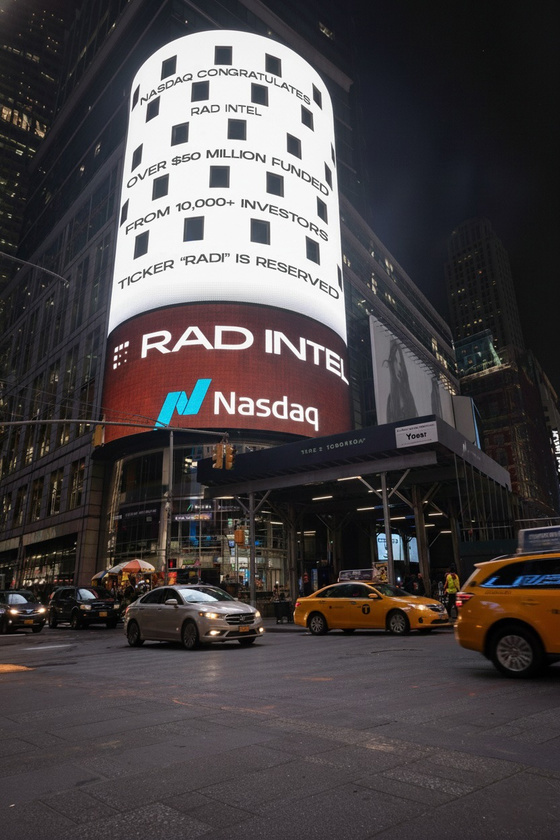
We are approaching the Reserve Cliff. The period where a private company prepares to cross the threshold into the public markets. RAD Intel has already reserved the ticker $RADI and has been featured in Times Square. This isn't just marketing; it’s a signal to the Whales that the window for Private Stimulus is closing.
When CEO Jeremy Barnett appears on Cheddar Business News from the floor of the NYSE, he isn't talking to the retail crowd. He’s signaling to the institutional desks that the infrastructure is ready. The revenue has doubled heading into 2026. The CAGR is holding at 127%. The Fortune 1000 contracts are recurring and seven-figure. This is the definition of Sticky Capital.
For the disillusioned investor, this is the Arbitrage you’ve been looking for. You aren't "buying a stock." You are extracting capital from an inefficient legacy system and placing it into a high-velocity AI node. The valuation has already climbed 4900%, but the public listing - the moment when the "Herd" finally gets access - is where the true Liquidity Injection happens.
The choice is binary. You can remain on the Treadmill, watching your purchasing power erode while you chase the latest "meme" trend. Or you can act with the Cold Calculation of an insider. The ticker is reserved. The giants are in. The price is $0.85. In the dark room of the global market, the lights are starting to flicker. Don't be the one left in the dark when the door closes.
|
Stay ahead of the current - subscribe free
Subscribe to Whales Investing
|
