

Introduction: Beyond the Mars Hype
In the arena of tech investment, few narratives move retail capital like those spinning around Elon Musk. When analysts like Jeff Brown of Brownstone Research tease the "biggest IPO of the decade" and the potential for life-changing returns on a $500 entry, the retail market pauses.
Whales, however, do not pause. We analyze.
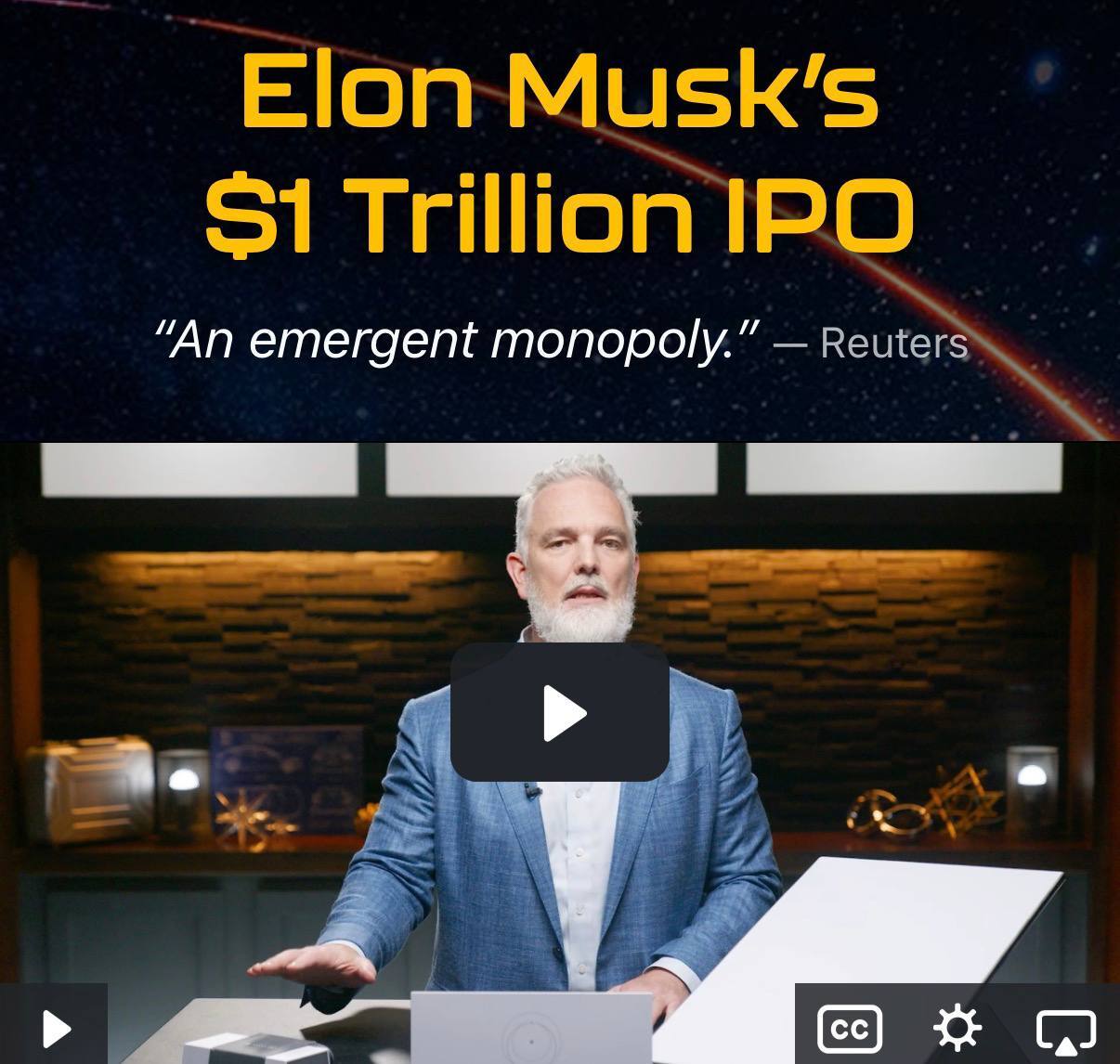
We have deconstructed Brown’s latest teaser. It points unmistakably to the entity he believes will be Musk’s next trillion-dollar enterprise. It is not Tesla. It is not SpaceX proper in its current form. It is what many mistake for Musk's side project, but what is, in reality, his primary cash-flow engine.
The Whales Investing Verdict: The target is Starlink.
Below is our institutional analysis of why "smart money" believes the true gold mine isn't on the ground, but in Low Earth Orbit (LEO), and the mechanics of how pre-IPO access is being structured for smaller investors.
The Trillion-Dollar Thesis: The First Global Utility

To grasp the scale of this opportunity, one must look past the rockets. The rockets are merely the delivery mechanism; the cargo is the business.
In his promotion, Brown makes a critical assertion: Musk is building "the world’s first global communications carrier."
The Macro View: Starlink is not merely broadband for rural areas. It is the construction of a telecommunications infrastructure layer that bypasses terrestrial cell towers, undersea cables, and geopolitical borders.
Traditional telecoms (AT&T, Verizon, Comcast) command hundreds of billions in market capitalization while serving fractioned regional markets. Starlink is targeting the entire planet with low-latency connectivity.
Total Addressable Market (TAM): The global internet access market is valued in the trillions.
De Facto Monopoly: Starlink has already established itself as the monopoly in next-generation satellite internet, currently serving over 2 million active subscribers and securing high-value defense contracts.
Brown’s assessment holds weight: If Starlink matures into a global utility, a valuation exceeding $1 Trillion upon a public listing is a plausible scenario.
The Moat: Vertical Integration Arbitrage
The most significant line in the teaser is a logistical fact, not a profit projection: "Every week, Elon is sending about 60 more satellites into orbit."
This is what institutional investors define as an Economic Moat.
Competitors - Amazon's Project Kuiper, OneWeb, sovereign projects from China and the EU - are hopelessly behind the curve. Why?
Pure Vertical Integration. SpaceX owns the launch vehicles (Falcon 9 and imminent Starship). Starlink manufactures the satellites. Musk launches his own hardware on his own rockets at internal cost.
Competitors must pay hundreds of millions at market rates for launch capacity (often... to SpaceX itself).
Starlink maintains an untouchable launch cadence, expanding its constellation at a velocity competitors cannot mathematically match.
This deployment speed makes Starlink the apex predator in LEO. While others plan, Starlink generates free cash flow. Musk has explicitly stated Starlink is the "cash cow" intended to fund the Mars mission. The most efficient way to monetize that cow is via a public listing.
The Deal Mechanics: Pre-IPO Access via Secondary Markets

This is the most critical aspect of the promotion for investors. Starlink is currently a private division of SpaceX. You cannot access it via a standard brokerage account.
How is access being offered for a $500 entry?
This involves accessing the Private Equity Secondary Market.
The Mechanism Explained:
Special Purpose Vehicles (SPVs): Investment firms (like the one Brownstone is recommending) establish a fund specifically designed to acquire private shares.
Sourcing Liquidity: This fund negotiates with early SpaceX employees or initial venture investors seeking liquidity before the IPO. The fund acquires these private share blocks wholesale.
Democratized Access: The fund then allows investors to purchase "units" or shares of that SPV. While these deals typically require accredited investor status and high minimums, certain structures allow lower entry thresholds (the mentioned $500).
The Risk/Reward Profile: This is not a Nasdaq trade. It is a private equity placement.
The Upside (Valuation Arbitrage): You are aiming to acquire equity at a private valuation significantly lower than the eventual public opening price - the mechanism behind the "biggest payout" claims.
The Risk (Illiquidity): Capital is locked. There is no secondary market for these SPV shares until a "liquidity event" (an IPO or acquisition) occurs. If the Starlink IPO is delayed for five years, your capital waits.
|
Sponsored Content
Top Picks from Partners We Trust
|
Conclusion
Starlink is not vaporware. It is a planetary-scale infrastructure asset with a proven business model and an insurmountable competitive advantage. A Starlink IPO would legitimately be one of the most significant capital market events of the decade.
The offer presented by analysts like Brown is a mechanism to access institutional-style pre-public equity. If an investor has the capital patience to withstand indefinite illiquidity in exchange for asymmetric upside potential, the thesis warrants serious due diligence.
|
Stay ahead of the current - subscribe free
Subscribe to Whales Investing
|